A Southeastern Utility Was Downgraded in February 2026. S&P cited capital planning documentation — not financial performance — and threatened to withdraw the rating entirely within 30 days. The trigger was a CIP documentation gap.
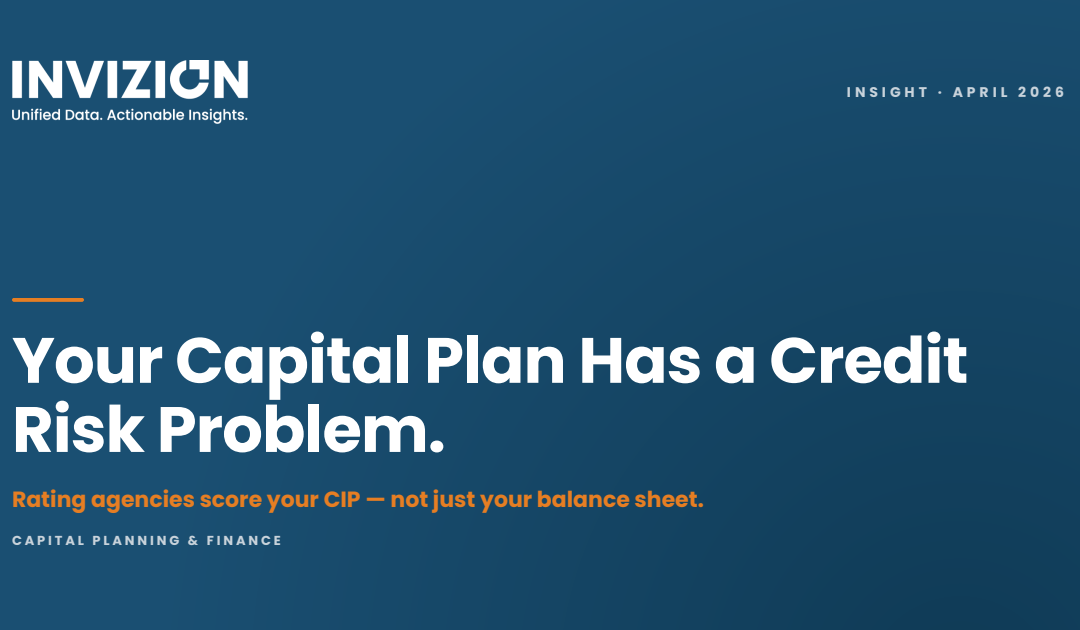
Your Capital Plan Has a Credit Risk Problem.
Rating agencies score your CIP — not just your balance sheet.
Moody's and S&P explicitly evaluate capital planning quality as part of municipal utility credit ratings. The gap between having a CIP and having audit-ready capital data is direct financial exposure — measured in basis points, change orders, and missed federal funding.

Section 1 of 3
What Rating Agencies Actually Evaluate.
Ask most utility finance directors what drives their bond rating and you will hear a familiar list: debt service coverage, days cash on hand, rate covenant compliance. These are real factors. They are also only part of the picture.
Moody’s U.S. Municipal Utility Revenue Debt Methodology explicitly includes management quality as a scored rating factor — alongside financial strength, system size, and legal provisions. The primary evidence of management quality, in a capital-intensive utility, is the capital plan itself: how it is constructed, how dynamic it is, how clearly it ties project schedules to funding sources, and how credibly it models execution capacity.
“The scale and complexity of a network’s capital investment plan provide important indications of execution risk, with programs potentially taking longer to complete or costing more than expected.”
Moody’s U.S. Municipal Utility Revenue Debt Methodology
S&P uses similar criteria. Its water utility framework evaluates the utility’s ability to fund and execute its capital program while sustaining financial performance — meaning analysts read your CIP for evidence of capacity, not ambition. A CIP thin on project-level detail is, from a rating perspective, a risk disclosure.
AA → AA-
S&P downgraded a southeastern water utility’s long-term bond rating and placed it on negative credit watch. In its action, S&P specifically requested “documents, data, and information regarding financial and capital planning” — and indicated it would withdraw the rating entirely if documentation was not provided within 30 days. The trigger was not financial failure. It was a capital planning documentation gap.
Section 2 of 3
Having a CIP Is Not Being Audit-Ready.
The AWWA 2025 State of the Water Industry survey found that 79.7% of utilities have a Capital Improvement Plan in place. That number sounds reassuring. It is less so when you examine what most of those plans actually contain.
The typical utility CIP is an annual document — updated once a year, built primarily in spreadsheets, organized by project name and year, with estimated cost figures rarely tied to specific funding sources, contractor assumptions, or rate model inputs. It answers “what are we planning to spend?” It does not answer how competing demands will be sequenced against a shared contractor pool, a rate trajectory, and multiple funding streams with different compliance dates.
That gap matters to rating agencies because they are evaluating execution capacity. A static, annually updated spreadsheet CIP tells them the utility knows what it wants to build. It does not tell them the utility can manage what happens when a major project slips, when construction costs inflate, or when a federal funding window closes because projects weren’t shovel-ready.
“Having a CIP” and “having a CIP that survives rating agency scrutiny” are not the same thing. The difference shows up in basis points — and in change order invoices.
Only 40.9% of AWWA respondents said they have a digital transformation strategy. Only 41% feel fully able to cover costs through rates. The water sector’s capital planning infrastructure has not kept pace with the scale and complexity of what it is being asked to plan.
Section 3 of 3
The Financial Cost of Capital Planning Weakness.
Rating agencies are one channel through which poor capital planning data becomes a financial problem. They are not the only one.
Borrowing Cost Exposure
A one-notch downgrade raises borrowing cost on every subsequent bond issuance. For a utility with a $200M CIP and a 30-year structure, the cumulative interest difference between AA and A is measured in millions — recovered through rates. A southeastern water utility is a concrete reminder that rating actions happen, cite capital planning quality specifically, and translate directly into exposure.
Change Order Costs
Projects that aren’t well-scoped at execution, sequenced without modeling contractor availability, or revised after commitments are made routinely accumulate change orders of 8 to 28% of contract value. On a $20M treatment project, that is $1.6 to $5.6M in avoidable cost — usually rooted in insufficient front-end planning data, not contractor performance.
Rate Case Compression
A rate case with a well-documented, multi-year CIP behind it moves through regulatory approval predictably. A rate case supported by a thin capital plan invites more scrutiny, longer timelines, and greater disallowance risk. With 48.5% of utilities seeking rate increases, CIP documentation quality is a competitive differentiator in front of rate-setting bodies.
Federal Funding Execution Risk
IIJA allocated $55B for water infrastructure, but only 18% reached projects. The common reason isn’t eligibility — it’s project readiness. Unscoped, unpermitted projects don’t meet the shovel-ready threshold before funding windows close. The authorization expires September 30, 2026.
The CFO’s credit risk exposure is not from a capital program that fails spectacularly. It is from one that can’t be documented — where the gap between what is planned and what is auditable lets rating agencies, regulators, and ratepayers draw their own conclusions. The cost of that gap is quantifiable.
Sources: AWWA 2025 State of the Water Industry Report · Moody's U.S. Municipal Utility Revenue Debt Methodology · S&P Water Utility Rating Criteria · UNC Environmental Finance Center Capital Planning Research · BirminghamWatch (February 2026) · AWWA does not sponsor, endorse, or affiliate with third-party companies, products, or services.