IIJA's Supplemental Water Funding Ended September 30, 2026. FY2027 opened on a continuing resolution at FY2026 base levels through December 11, with no IIJA layer and no SRF reauthorization enacted.
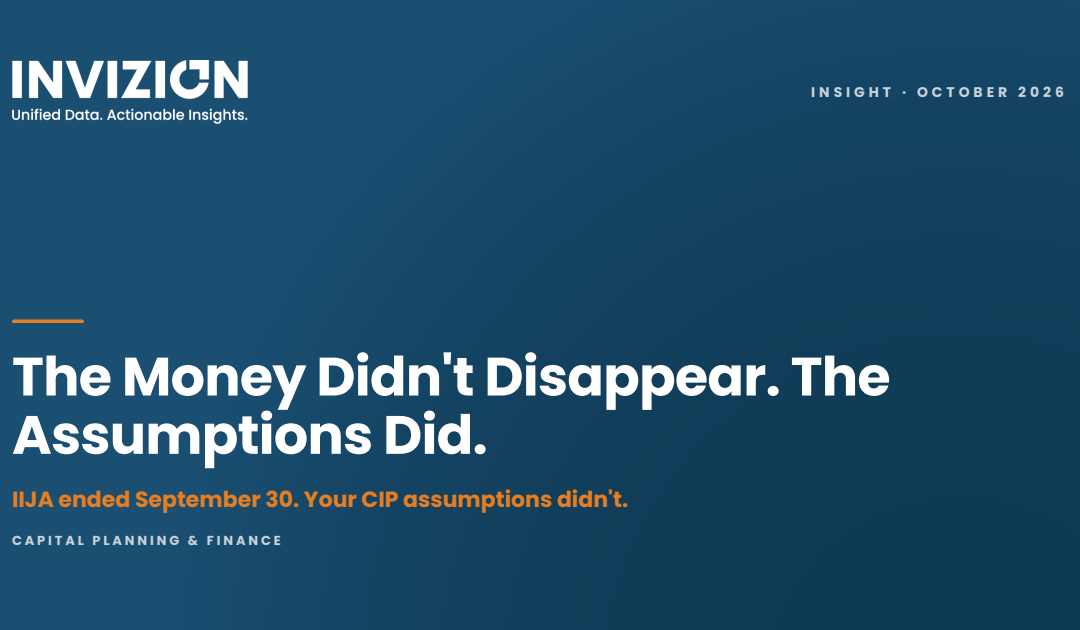
The Money Didn’t Disappear. The Assumptions Did.
IIJA ended September 30. Your CIP assumptions didn't.
The last IIJA supplemental appropriation has been made, SRF and WIFIA authorizations have lapsed, and FY2027 opened on a stopgap. Billions in IIJA dollars are still moving through the pipeline, but every one now carries a deadline, and the base program behind them is shrinking. The question for a utility CFO is no longer whether federal funding is changing. It's which assumptions in your capital plan were built on it.

The Cliff Is Four Clocks.
On September 30, 2026, the Infrastructure Investment and Jobs Act’s five years of supplemental water funding ended. In its final year, that layer added $2.6 billion to each State Revolving Fund, $3 billion for lead service lines, and more than $1 billion for emerging contaminants. The same day, the SRF and WIFIA authorizations lapsed. FY2027 opened on a continuing resolution that holds EPA at FY2026 base rates through December 11 — with no IIJA layer and no reauthorization.
“The funding cliff” sounds like one event. It is four federal clocks on different schedules, and each one hits a capital plan differently.
What Ended and What Didn’t
The IIJA appropriations are finished. The IIJA money is not. Bluefield Research’s August 2026 analysis found $26.8 billion of $40.7 billion in IIJA-backed SRF allotments had not yet reached project-level agreements, and expects those dollars to reach utilities into the early 2030s. But the dates are fixed: capitalization grants carry a two-year period of availability before unobligated funds are reallotted, and ARPA recovery dollars used for water projects must be spent by December 31, 2026, or returned to Treasury.
The Base Is Shrinking Underneath
In FY2026, roughly $1.6 billion of SRF appropriations went to congressionally directed earmarks — one-time grants that never revolve — against about $1.15 billion in actual capitalization grants. The House Appropriations Committee’s FY2027 Interior-Environment bill would cut the Clean Water SRF from $1.639 billion to $1.192 billion and the Drinking Water SRF from $1.126 billion to $910 million, while carrying more than $1 billion in water earmarks. Bluefield projects total federal water infrastructure funding falling about 63%, from $23.4 billion in FY2026 to roughly $8.6 billion in FY2027.
The IIJA appropriations are finished. The IIJA money is not — and every dollar still in the pipeline now carries a date.
Where the Exposure Sits.
Invizion reviewed EPA’s FY2026 SRF allotment tables and six states’ current intended use plans to see what the end of IIJA looks like where utilities actually apply. In Texas, New York, Minnesota, California, Ohio, and Michigan, IIJA funds made up 82–86% of FY2026 federal SRF capitalization before lead line funds, and roughly 87–90% with them. IIJA was not a supplement to these programs. It was the program.
Oversubscription Is the New Normal
- New York: more than $6.9 billion in identified clean water demand; available assistance would cover about 25% of it, with about $30 million in additional subsidy for the year.
- California: available drinking water grant and forgiveness funding (federal and state) falls from $1.27 billion to $942 million, and staff project new federal forgiveness averaging about 84% below the prior six-year average from FY27/28.
- Minnesota: a draft $989 million fundable list against about $169 million a year in sustainable lending capacity.
- Texas: base federal drinking water SRF allotment down about 65% in one year; applications now by invitation only.
Subsidy Goes First
States can keep lending with bond proceeds and loan repayments. They cannot replace grants that way. Principal forgiveness tracks federal dollars most closely, which is why California is already warning about it. Ohio is the counterexample — its 2027 drinking water plan can fund all expected projects. Exposure also runs beyond the SRF: Bluefield found 16 states, including South Carolina and Mississippi, drew more water funding from ARPA than from SRF or WIFIA, and those dollars hit a hard December 31 deadline.
States can keep lending with bond proceeds and loan repayments. What they cannot replace is the grant.
What Changes Inside the CIP.
In our experience, many five-year CIPs written in 2023 or 2024 assume IIJA-era federal participation in their out-years. That assumption changed on September 30.
Four Places the Plan Breaks
Out-year SRF loans now compete for a far smaller pool. Assumed principal forgiveness is the most exposed number in most financing plans. Awards not yet under agreement run on reallotment clocks. ARPA-funded scope unspent by December 31 moves onto the rate base. And reauthorization, if it comes, only sets ceilings — appropriations are moving the other way.
The mandates did not change. The 2024 PFAS rule remains in effect — monitoring by April 26, 2027, PFOA/PFOS limits by April 26, 2029 — while litigation and EPA’s May 2026 proposals (rescinding four standards; exemptions to 2031 for qualifying systems) are pending.
September 30 did not take money out of your capital plan. It took the certainty out of the money that was in it. A defensible CIP now treats federal participation as a scenario to model, not a line item to assume.
Sources: Bluefield Research, Federal Water Funding “Cliff” Masks Four Distinct Timelines (Aug. 17, 2026) · Water Finance & Management (June 12 and Oct. 12, 2026) · CRS R49353, Continuing Appropriations for FY2027 (Sept. 17, 2026) · U.S. EPA FY2026 SRF allotment tables, LSLR allotment memo, and reallotment procedure · U.S. Treasury SLFRF FAQ (Aug. 2026) · SFY/FFY2027 intended use plans: Texas TWDB (DWSRF), NY EFC (CWSRF), Minnesota PFA (CWSRF draft), California SWRCB (DWSRF, CWSRF; July 2026 workshop), Ohio EPA (DWAF) · Senate EPW, WRDA 2026 (July 15, 2026); US Water Alliance (July 17, 2026); RCRC on H.R. 9497 (Sept. 18, 2026); Holland & Knight (Oct. 2026) · U.S. EPA Lead and Copper Rule Improvements (89 FR 86418, Oct. 2024), LCRI FAQs (June 2026), and DWINSA update (Nov. 2025) · U.S. EPA PFAS National Primary Drinking Water Regulation (89 FR 32532, Apr. 2024); Federal Register 2026-10085/-10086 (May 2026); Jones Day (May 2026) · IIJA share calculated by Invizion from EPA FY2026 allotment tables; state lead line shares from EPA's May 2026 LSLR memo and Environmental Policy Innovation Center, approximate.